
Metal Dry Cutting Blades
TCT blades for selected thin-wall steel, pipe, profile and low-spark dry cutting applications where carbide geometry and machine stability are controlled together.
Custom TCT circular saw blades for metal dry cutting, aluminum profiles, color steel tile and selected non-ferrous or panel applications where carbide tooth geometry matters.
TCT BLADE BASICS
A TCT saw blade is a tungsten carbide tipped circular saw blade. The carbide tips are brazed to a steel body and selected by tooth form, hook angle, kerf, plate thickness, bore, tooth count, machine condition and cutting material.
Carbide tipped circular saw blades for aluminum, non-ferrous profiles, color steel, selected light-gauge metal cutting and application-fit panel or composite work.
TCT blades are normally quoted as outer diameter × kerf/plate thickness × bore × tooth count, for example 285 × 2.0/1.75 × 32 × 80T. The slash separates cutting width and base body thickness.
Many TCT blades use silencing slots or noise-reduction lines. For high-speed steel tube or stainless circular sawing machines, check whether the blade should actually be HSS or cermet rather than ordinary TCT.
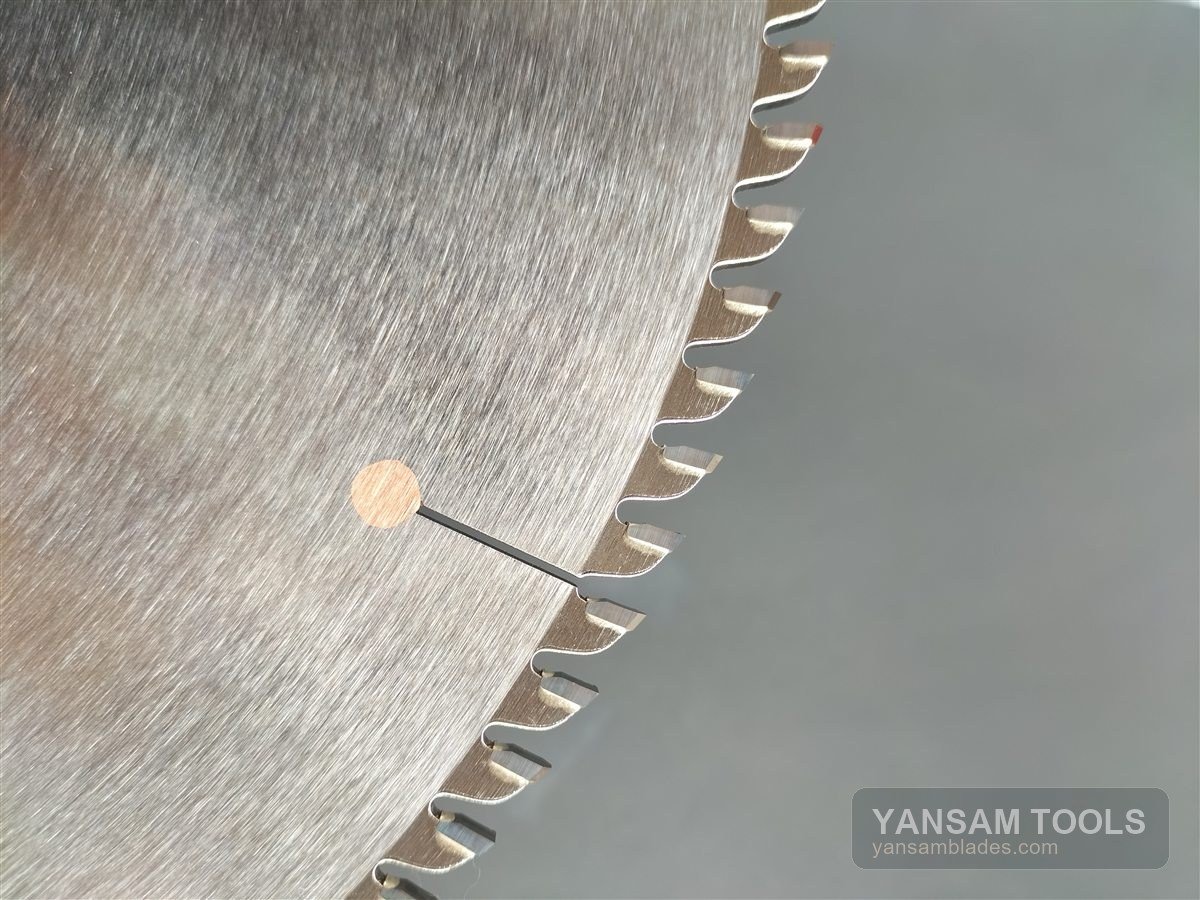
TCT saw blades can be configured for metal dry cutting, aluminum profiles, color steel tile, non-ferrous sections and selected panel work. We choose tooth profile, carbide grade, body thickness, kerf, arbor and pin hole layout from the real machine and material condition.
Based on the product catalog, this page prioritizes TCT carbide tipped blades for metal cutting, aluminum profiles, color steel tile and adjacent industrial applications. HSS blades and cermet cold saw blades stay on their own pages to keep the application boundary clear.
TCT blades for selected thin-wall steel, pipe, profile and low-spark dry cutting applications where carbide geometry and machine stability are controlled together.
TCT blades for aluminum profiles, radiators, door and window profiles, copper alloy and other non-ferrous materials.
Application-specific blades for coated sheet, corrugated roofing material and similar light-gauge sections where burr and deformation must be controlled.
Profile blades for copper alloy, brass and similar sections that need clean edge finish and dependable clamping support.
Electronic cutting saw, sliding table saw, plywood, MDF, chipboard and laminated board blades for clean panel edges.
Single and double scoring blades for pre-slotting double veneered chipboard, MDF and laminated panels.
Bamboo, waterproof board, adhesive-rich material and Teflon coated blade options for difficult surfaces.
Custom bore, locating pins, carbide grade, plate design and tooth geometry for repeat replacement supply.
TCT can be a practical metal-cutting direction, but only for the right material thickness, machine type and line speed. This is also where buyers often confuse TCT with HSS or cermet cold saw blades.
| Cutting Condition | Can TCT Work? | What To Check First |
|---|---|---|
| Aluminum profiles and non-ferrous sections | Yes, commonly | Profile shape, wall thickness, clamping, lubrication and burr target |
| Color steel tile and coated sheet | Yes, in selected blade/machine combinations | Sheet thickness, vibration, coating surface, tooth count and heat control |
| Thin-wall carbon steel profile or light-gauge tube | Sometimes | Machine rigidity, feed stability, blade body, carbide grade and whether the application is really dry cutting |
| High-speed stainless tube or steel bar production | Usually no | Check whether HSS or cermet cold saw blade is the correct family before quoting |
| One blade for both aluminum and steel | Usually no | Material family, tooth geometry, edge finish and blade life target should be reviewed separately |
The table below turns the catalog product range into a clearer selection map for industrial buyers. Final dimensions still need to match the machine and sample blade.
| Product Type | Typical Material | Machine / Use | Selection Focus |
|---|---|---|---|
| Multi-rip with rakers | Log, square timber, softwood and hardwood | Conventional multi-blade saw machine | Chip evacuation, heat dissipation, resin control and blade life |
| Ultra-thin multi-rip / ultra-thin blade | Softwood, hardwood and general wood stock | Multi-blade saw, square timber saw and suitable table saws | Material saving, machine stability and lower kerf load |
| Solid wood cross cut / rip cut | Solid wood, plywood and composite wood | Sliding table saw and double-end milling machines | Cut direction, tooth count, chip space and surface finish |
| Electronic cutting / sliding table blade | Melamine board, MDF, chipboard and composite board | Electronic cutting saw, reciprocating saw and sliding table saw | Clean edge, low chipping, carbide grade and matching scoring blade |
| Single / double scoring blade | Double veneered chipboard and MDF | Pre-slotting before main panel cutting | Kerf match, scoring depth, arbor fit and chipping control |
| Grooving blade | Wood back plate and aluminum-plastic plate | Woodworking machinery, electric saw and vertical milling equipment | Groove width, bottom flatness, body rigidity and tooth profile |
| Plywood / bamboo / waterproof board blade | Plywood, bamboo board, waterproof board and adhesive panels | Trimming machines, special bamboo saws and sliding table saws | Non-stick cutting, smooth edge, no burr and resin build-up control |
| Aluminum / non-ferrous profile blade | Aluminum profile, copper alloy, plastic steel and abrasive composite panels | Profile cutting machines, angle saws and production saws | Burr control, carbide support, coating choice and clamping stability |
| Metal dry cutting blade | Light-gauge steel section, color steel tile and selected thin-wall metal | Dry cutting machines with stable clamping and suitable guarding | Blade rigidity, carbide toughness, tooth count, heat and spark control |
These are reference ranges organized from the TCT catalog. They are not a fixed stock list; we confirm final blade size by drawing, machine model or sample blade.
| Blade Series | Reference Diameter | Kerf / Plate | Common Arbor | Typical Teeth |
|---|---|---|---|---|
| Multi-rip saw blade with rakers | 180-1000 mm | 1.8-8.5 mm kerf | 30 / 35 / 40 / 50 / 60 / 70 / 80 mm | 18+2T, 24+2T, 36+4T, 40+8T |
| Ultra-thin saw blade | 180-300 mm | 1.3-2.0 mm kerf | 25.4 mm | 60T, 80T, 100T |
| Solid wood cross cutting blade | 305-1000 mm | 3.2-8.0 mm kerf | 25.4 / 40 / 50 mm | 80T, 100T, 120T |
| Solid wood rip cutting blade | 305-1000 mm | 3.2-8.0 mm kerf | 25.4 / 40 / 50 mm | 40T, 48T, 60T, 80T |
| Electronic cutting and sliding table blade | 300-400 mm | 3.2-4.4 mm kerf | 30 / 60 / 80 mm | 72T, 80T, 84T, 96T |
| Single / double scoring blade | 100-200 mm | 2.8-5.3 mm adjustable kerf | 20 / 22 / 30 mm | 12+12T, 24T, 40T |
| Aluminum saw blade | 250-500 mm | 2.8-4.4 mm kerf | 25.4 mm | 120T |
| Teflon coated blade | 165-305 mm | 1.5-2.4 mm kerf | 16 / 20 / 25.4 / 30 mm | 24T, 40T, 48T, 54T, 60T, 80T |
| Metal dry cutting / color steel tile blade | 230-405 mm | 2.8-3.4 mm kerf | 32 / 40 mm | 80T, 100T, 120T |
TCT blade performance depends on the carbide tip, steel body, tooth geometry and the real machine condition working together.
| Cutting Material | Selection Focus | Key Details To Confirm |
|---|---|---|
| Solid wood and softwood | Hook angle, tooth count and chip space for smooth feeding | Rip or cross cut, moisture, feed speed and required edge finish |
| Plywood, MDF and laminated panels | Clean edge, anti-chipping design and matching scoring blade if needed | Panel thickness, coating layer, cutting direction and chipping position |
| Aluminum profile | Fine surface, low burr, stable clamping and suitable tooth geometry | Profile drawing, wall thickness, alloy grade, coolant and machine clamp |
| Thin-wall carbon steel or dry-cut profile | Carbide toughness, blade body rigidity, machine guarding and heat control | Material grade, section size, wall thickness, feed stability and whether HSS/cermet is a better fit |
| Color steel tile | Blade rigidity, carbide grade, tooth strength and reduced deformation | Sheet thickness, coating surface, cutting speed and whether the material vibrates |
| Non-ferrous profile | Low burr edge, stable chip removal and correct hook angle | Alloy family, section drawing, clamp area and finish expectation |
| Plastic, composite or special material | Heat control, chip discharge and sample testing before batch production | Material sample, melting risk, surface requirement and production quantity |
The same diameter and tooth count can cut very differently if the tooth form, carbide grade or plate tension is wrong.
Often used for wood, panels and clean cross cutting where edge quality is important.
Commonly discussed for aluminum profiles, metal dry cutting, laminated boards and materials that need stronger edge support.
Can be suitable for ripping, grooving or applications where chip space and stable feed are important.
Hardness and toughness must match the material. A harder tip is not always better if the application has impact or vibration.
Body thickness, kerf and tension affect stability, heat and power load. Thin kerf needs more attention to machine condition.
Arbor, keyway and locating holes should match the machine exactly. A sample blade or drawing prevents installation mistakes.
When cutting results are unstable, the reason is often a combination of blade choice, machine condition and workpiece control.
For a fast and accurate TCT blade quotation, send the current blade data and the real cutting condition. Photos of the blade mark, machine nameplate and the cut edge are especially helpful for metal-cutting applications.
What buyers usually ask before ordering.
Yes, but only in selected applications such as aluminum, non-ferrous profiles, color steel tile and some light-gauge steel dry cutting jobs. Material grade, wall thickness and machine rigidity must be checked before choosing TCT for metal cutting.
TCT is common for aluminum and selected dry cutting jobs. HSS or cermet is usually a better starting point for high-speed steel tube, stainless tube and bar production cutting. If the buyer is not sure, send the machine and material first.
Usually not. Aluminum and steel often need different carbide grade, tooth geometry, body rigidity and cutting parameters. A shared blade normally reduces finish quality or blade life.
Please send outer diameter, kerf, plate thickness, arbor, pin holes, tooth count, tooth shape if known, machine type, material grade, section size, wall thickness, target finish and the current cutting problem.
Check tooth geometry, tooth count, carbide sharpness, feed speed, clamping, cooling, chip evacuation and whether the chosen blade family fits the material. In some steel jobs, the fix is switching from TCT to HSS or cermet.
Yes. Non-standard diameter, arbor, pin holes, tooth count, carbide grade, coating and packaging can be discussed for OEM buyers and repeat production orders.
For TCT blades, the material family and machine condition decide tooth geometry, carbide grade, hook angle and plate design.
Best first message: material grade + machine type + blade size + wall thickness + edge problem + quantity.
Use these pages to connect TCT blade choice with metal-cutting boundary, machine stability and required finish.
Use this guide when a buyer says TCT but the application may actually be a cermet cold saw job.
Compare when metal cutting should move to HSS circular saw blades or cermet cold saw blades.
Share material grade, profile size, current blade data, machine and finish requirement.
TCT blades should not be selected only by diameter and tooth count. Carbide grade, tooth geometry, plate tension, kerf and application material decide the final cutting result.
Confirm wall thickness, spark control, machine rigidity and whether the job should stay with TCT or move to HSS/cermet.
Confirm profile shape, clamping, lubrication, burr target and chip evacuation.
Keep wood or panel applications separated from metal jobs. Send sample photos or a drawing when tooth shape or carbide grade is special.
Send the machine model, current blade size, material and cutting problem. Drawings, nameplate photos or sample photos help us confirm the specification faster.
No. Carbide grade, tooth geometry, kerf, plate tension, material and feed condition also decide the final cutting result.
Yes. Aluminum profile blades should be selected by profile shape, wall thickness, clamping, lubrication and required surface finish.
Usually not. Aluminum, light-gauge steel dry cutting and panel applications often need different carbide grade, tooth geometry and edge support.