
Do Not Start With A Tooth Name Only
Many blade inquiries start with a short question: “Can you make this tooth form?” The problem is that tooth form names are not used in exactly the same way across HSS blades, TCT blades, cermet cold saw blades and cermet flying saw blades.
For a reliable recommendation, the tooth form must be read together with the machine, material, wall thickness, feed method, line speed and cutting problem. A close-up tooth photo is useful, but it should not be the only basis for classification.
A coated cermet cold saw blade and a cermet flying saw blade may both be circular blades with fine teeth, but their cutting processes can be completely different.
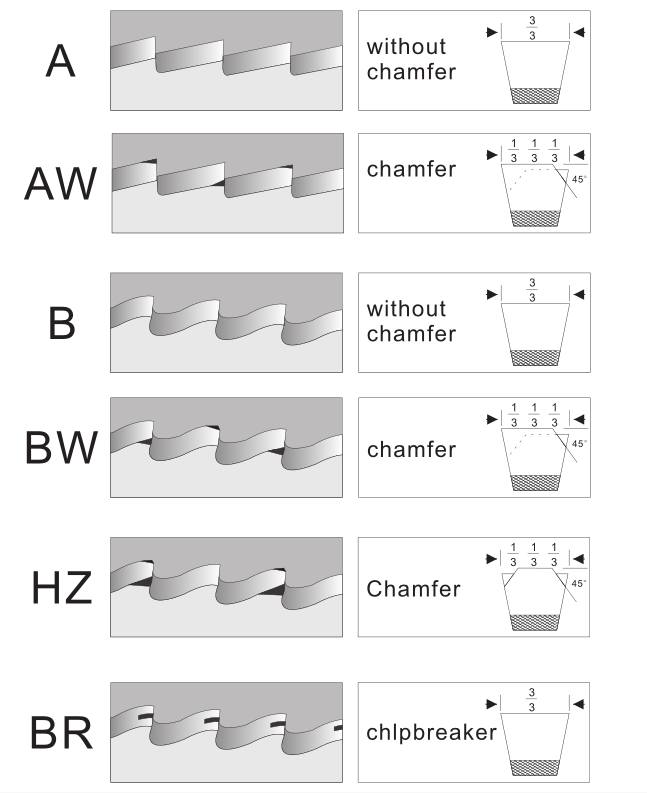
HSS blades may use names such as A, AW, B, BW, HZ and BR. TCT blades often use ATB, FTG and TCG. Flying saw blades may be described by R tooth or P tooth in some tube mill applications.
A fixed circular sawing machine, automatic tube cutting machine, aluminum profile saw and ERW tube mill flying saw do not load the teeth in the same way.
If a buyer sends only diameter and tooth count, the supplier may still need bore, pin holes, kerf, plate thickness, material and working condition before quoting.
Quick Comparison
| Blade Type | Tooth Form Logic | Typical Application | What To Confirm |
|---|---|---|---|
| HSS / GF saw blade | Integral high speed steel teeth. Tooth pitch, rake angle, clearance angle, chamfering, chip breaker and set are important. | Metal tube cutting, orbital tube cutting and small precision pipe preparation. | OD, thickness, bore, tooth count, material, wall thickness, machine speed and burr problem. |
| TCT saw blade | Carbide tips are brazed onto the body. ATB, FTG, TCG and combination teeth are common in many TCT applications. | Wood, aluminum, profiles, non-ferrous metal and some steel material dedicated TCT blades. | OD, kerf/plate thickness, bore, tooth count, material, profile section and whether damping slots are required. |
| Cermet cold saw blade | Cermet tips are selected for steel cutting quality. Tooth angle, coating, machine rigidity and cutting stability matter more than a simple visual name. | Steel tube, steel bar, profile and high-quality end cutting on circular sawing machines. | Machine model, material, section size, blade size, locating holes, cut quality and life requirement. |
| Cermet / cermet flying saw | Designed for online tube cut-off. Tooth geometry must handle moving tube, weld seam impact and short cutting cycles. R tooth and P tooth may appear in some naming systems. | ERW tube line, online cold flying cut-off and fixed-length tube cutting during continuous production. | Flying saw machine model, line speed, weld seam condition, tube OD and wall thickness, cut length and current blade photos. |
HSS Saw Blades: Tooth Pitch, Angles And Chamfering Matter
HSS circular saw blades and GF blades are usually not carbide-tipped. The cutting edge is formed from high speed steel itself through tooth grinding, heat treatment, surface treatment and sharpening. This is why HSS tooth form discussion is closer to tooth pitch, tooth height, rake angle, clearance angle, chamfering and chip breaking.
In HSS cutting, tooth count and tooth pitch directly affect entry stability and chip space. Thin-wall tubes normally need finer teeth, while thick-wall tubes or solid material need more chip space. Rake and clearance angles should also be matched with material such as low carbon steel, medium carbon steel, stainless steel, aluminum or copper.
When a customer asks about HSS tooth form, ask for material, wall thickness, blade OD, thickness, bore, tooth count, machine speed and the actual cutting problem. One tooth name alone is not enough.
TCT Saw Blades: ATB, FTG And TCG Are Common Names
TCT saw blades use carbide tips brazed onto a steel body. In woodworking, aluminum cutting, plastics and non-ferrous metal applications, tooth names such as ATB, FTG and TCG are common.
These names are helpful, but they should not be copied directly into every metal cold saw or flying saw discussion. Metal cutting tooth geometry depends strongly on machine rigidity, cooling, cutting speed, material strength and blade body design.
Cermet Cold Saw Blades: Do Not Judge Only By Looking Like TCT
A cermet cold saw blade may also have tips and coating, so buyers sometimes confuse it with TCT saw blades. In steel cutting, however, the key points are cermet tip material, cutting angle, coating, end face quality, machine stability and material match.
A normal cermet cold saw blade is usually used on a circular sawing machine, automatic tube cutting machine, bar saw or profile cutting machine. The workpiece is normally clamped or controlled before cutting, and the blade feed is more predictable than an online tube mill process.
Cermet Flying Saw Blades: R Tooth And P Tooth Belong To Line Cutting Logic
In some tube mill catalogues, online cold flying saw blades may be described with terms such as R tooth for non-weld-bead tube and P tooth for tube with weld bead. This is important because it shows that cermet flying saw tooth form is not a simple replacement for normal cermet cold saw tooth form.
A flying saw blade cuts while the tube continues moving on the production line. The saw carriage follows the tube, completes the cut inside a short cycle and must deal with line speed, synchronization, weld seam position, tube vibration and wall thickness. This changes the load on the teeth.
Flying saw teeth, normal cermet cold saw teeth and some TCT teeth may look similar in photos. A supplier can use tooth form as an important clue, but classification should still be confirmed with machine type, whether the cut is online, weld bead condition, line speed, clamping method and current blade data.
What Buyers Should Send For Tooth Form Identification
When a buyer sends a tooth photo, ask for the following information before making a technical decision:
- Blade outer diameter, thickness or kerf, bore and tooth count.
- For TCT and cermet: kerf/plate thickness and tip geometry.
- For HSS and GF: OD, thickness, bore, tooth count and material grade.
- Machine type and model: fixed saw, circular sawing machine, orbital cutter or flying saw.
- Material, tube OD, wall thickness, profile section or solid bar diameter.
- Whether the tube stops before cutting or the saw moves with the running line.
- Whether there is a weld bead or seam impact.
- Current cutting problem: burr, short life, broken teeth, vibration or rough surface.
- Clear photos of both blade sides, close-up tooth photos and machine nameplate if available.
Practical Conclusion
A saw blade tooth form is not just a shape. It is part of a cutting system. HSS, TCT, cermet cold saw and cermet flying saw blades should be judged by different logic.
For fast and accurate recommendation, send blade photos together with machine, material and cutting condition. This prevents a normal cold saw blade from being quoted for a flying saw line, and prevents TCT tooth names from being used where HSS or cermet terminology is more appropriate.